

Urban Philology
Urban Philology is a developing artistic research methodology at the intersection of Modern Philology, Urban Research, painting, calligraphy, and site-specific practice.
The contemporary city is a material text and a living palimpsest. Urban surfaces are not neutral backgrounds—what is written, preserved, erased, overwritten, or rendered invisible directly determines what can be remembered and what disappears.
By examining physical, textual, and material traces—archaeologies of lime, posters, inscriptions, repairs, and lacunae—the practice adopts the role of a Critical Editor of the urban palimpsest. Rather than representing the city, Urban Philology collects, correlates, and transforms these urban "witnesses," using painting as a space for analytical inquiry and knowledge production.
WORKING PRINCIPLES
city → selection → studio → transformation → return → new reading
READ
COLLECT
ANALYSE
TRANSFORM
RETURN
Reading the material and textual traces of the city.
Gathering images, inscriptions, fragments, documents and urban traces.
Comparing, isolating and contextualising the collected material.
Translating the research through painting, calligraphy and material processes.
Returning the transformed research to the city through exhibition and site-specific practice.
Selected Works
Material Studies
Berlin, 2026
An ongoing studio investigation into the material conditions of urban memory.
The Material Studies are not preparatory sketches, but autonomous research objects through which Urban Philology is tested materially in the studio.

artwork

detail 1

detail 4
artwork
MATERIAL STUDY #01
Berlin, 2026
-
Medium / Materials: Black aerosol stencil, political print transfer, white marker, ink, graphite, slaked lime, rubber stamp impressions on canvas.
-
Urban Condition: Resistance · Subcultural Topography · Grid.
-
Research Context: Neukölln, Berlin
-
Research Focus: A study of how political and subcultural inscriptions coexist within an ordered urban surface, and how traces of resistance remain legible through layering and material interruption.

front

detail 1

detail 2
front
MATERIAL STUDY #02
Berlin, 2026
-
Medium / Materials: Red acrylic emulsion, transferred street-signage typography, white ink calligraffiti, paper paste-ups, graphite on canvas.
-
Urban Condition: Institutional Signage · Overpainting · Drip Friction.
-
Research Context: Kreuzberg / Friedrichshain.
-
Research Focus: A study of the tension between regulated urban typography and informal inscription, focusing on how overpainting alters the authority and legibility of public signs.

lateral left

front

lateral right
lateral left
MATERIAL STUDY #08
Berlin, 2026
-
Medium / Materials: Slaked lime plaster, typewriter archival notes, dark ink calligraffiti, graphite, white fluid-marker script on canvas.
-
Urban Condition: Whitewashing · Archival Erasure · Palimpsest
-
Research Context: Mitte / Berlin Archive Fieldwork
-
Research Focus: The tension between archival classification, deliberate erasure and the persistence of residual inscription.
 MATERIAL STUDY #03 Berlin, 2026 Medium / Materials Indian ink, red aerosol emulsion, slaked lime, photographic paper transfers, script markers, scraped plaster on canvas. Urban Condition Concentric Vectors · Subcultural Archive · Overwriting Research Context Schöneberg / URBAN NATION, Berlin Research Focus A study of layered urban imagery and calligraphic movement, examining how successive inscriptions transform an existing visual archive. |  Detail |  Berlin, 2026 Medium / Materials Ink, acrylic markers, slaked lime, graphite, transferred paper, dust on canvas. Urban Condition Layering · Erasure · Inscription Research Context Berlin Research Focus A study of the coexistence of inscription and erasure within a single material surface. |
|---|---|---|
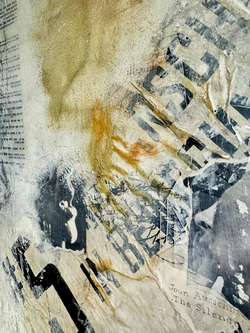 Detail |  Medium / Materials Transferred poster fragments, archival print, graphite, slaked lime, earth pigments, typewriter script on raw canvas. Urban Condition Fragment · Inscription · Temporal Layering Research Context Mitte / Neukölln, Berlin Research Focus A study of fragmented urban documents and their capacity to retain traces of different temporal and social layers. |  Detail |
 Medium / Materials Indian ink, stencil, red aerosol emulsion, slaked lime, photographic paper transfers, script markers, scraped plaster on canvas. Urban Condition Concentric Vectors · Subcultural Archive · Overwriting Research Context Kreuzberg / URBAN NATION, Berlin Research Focus A study of layered urban imagery and calligraphic movement, examining how successive inscriptions transform an existing visual archive. |  Medium / Materials Slaked lime plaster, stencil, stickers, typewriter archival notes, dark ink calligraffiti, graphite, white acrylic marker script on canvas. Urban Condition Whitewashing · Archival Erasure · Palimpsest Research Context Mitte / Berlin Archive Fieldwork Research Focus A study of the tension between archival classification, deliberate erasure and the persistence of residual inscription. |  Detail |